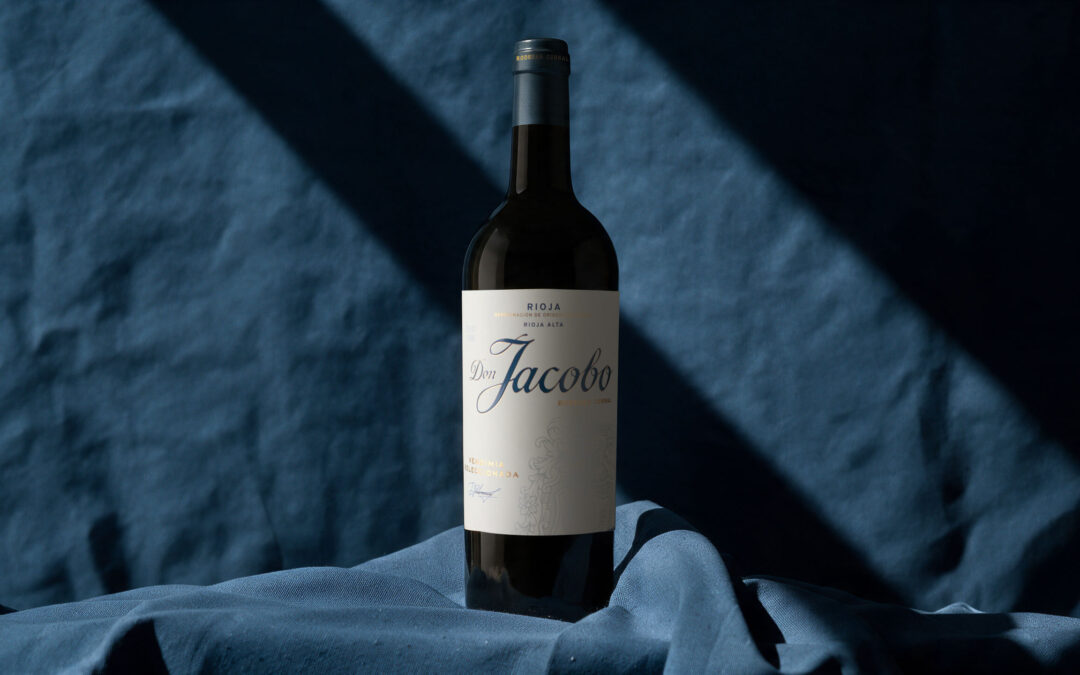
Don Jacobo Selected Vintage: much more than just a new label
A few weeks ago, we told you about the rebranding of Don Jacobo Vendimia Seleccionada – a new look that updates the label and gives it a more contemporary feel. But, just as with people, a change in appearance might catch our eye, even though what’s really interesting lies beneath the surface.
That’s why today we want to go a step beyond the label and tell you what you’ll find inside a bottle of Don Jacobo Vendimia Seleccionada 2025. And to do that, who better to turn to than someone who has known this wine from the very beginning: Daniel Hernando, winemaker at Bodegas Corral.
Because this Vendimia Seleccionada isn’t simply the result of choosing a grape variety and deciding how long it spends in the barrel. Behind it lies a very specific quest: to achieve a Rioja in which fruit, freshness and fluidity take centre stage.
 The difference begins in the vineyard
One of the key features of Don Jacobo Vendimia Seleccionada lies precisely in its origin. In producing it, we focus on higher-altitude vineyards – plots that allow us to work towards a fresher, fruitier profile.
Selection, therefore, is not simply a matter of choosing the grapes we consider to be the best. The key is to choose those that best suit the wine we wish to produce.
The result is based on 100 per cent Tempranillo, a variety closely linked to Rioja, but interpreted here from a perspective that seeks to enhance the fruit and maintain a sense of freshness and fluidity.
And this is where one of the fundamental differences from other Rioja wine profiles lies. As Daniel Hernando explains, “Vendimia Seleccionada is not the little brother of Crianza; it is another expression of Rioja”.
It is not a question of pitting the two against each other. They are wines with different objectives. In the case of Vendimia Seleccionada, we aim for the high-altitude vineyard, the fruit, the freshness and the fluidity to define its personality.
A two-stage approach to child-rearing
We come to another of the factors that explain why this wine is the way it is: its ageing.
When we talk about a barrel-aged wine, it’s easy to focus solely on the number of months. But with Don Jacobo Vendimia Seleccionada, there’s something even more interesting behind the scenes.
After fermentation, the wine is transferred to 225-litre American oak barrels. This first stage serves a specific purpose: to impart structure, complexity and a slow evolution, whilst using the oak in a controlled manner.
Then comes the second part of the process. Once the desired level of integration has been achieved, the wine continues its refinement outside the barrel. It is then that the fruit comes back to the fore.
Daniel sums it up particularly clearly: “First we use the wood to give the wine structure; then we let the fruit take centre stage again.”
And that is the key. We do not want the wood to dominate the glass, but rather for it to help build the wine and then make way for what we wanted to preserve from the vineyard.
 So what do we actually find in the glass?
All this hard work has to pay off when we serve the wine. And Don Jacobo Vendimia Seleccionada 2025 boasts a medium-depth ruby red colour with brilliant highlights.
On the nose, there are notes of fresh red berries, accompanied by delicate spicy undertones and a slight balsamic note. On the palate, this is a well-rounded, flavourful and balanced wine, with a smooth texture and fine tannins that provide structure without being harsh.
The fruit lingers right to the finish, leaving an elegant, clean aftertaste. It is precisely this combination of fruit, freshness and well-integrated ageing that defines the profile we are seeking.
We recommend serving it at between 15 and 18 ºC, a temperature that allows you to enjoy its aromas and its balance on the palate. It is, moreover, a wine designed to be enjoyed with a meal, pairing well with everything from meats and cold cuts to cheeses and traditional dishes.
So yes, we’ve revamped the label. But there’s much more to it than just that new look: high-altitude vineyards, Tempranillo, a two-stage ageing process and a different way of understanding Rioja.
Because, at the end of the day, a label might be the first thing that catches your eye on a bottle. But what makes you want to come back to it is what’s inside.