
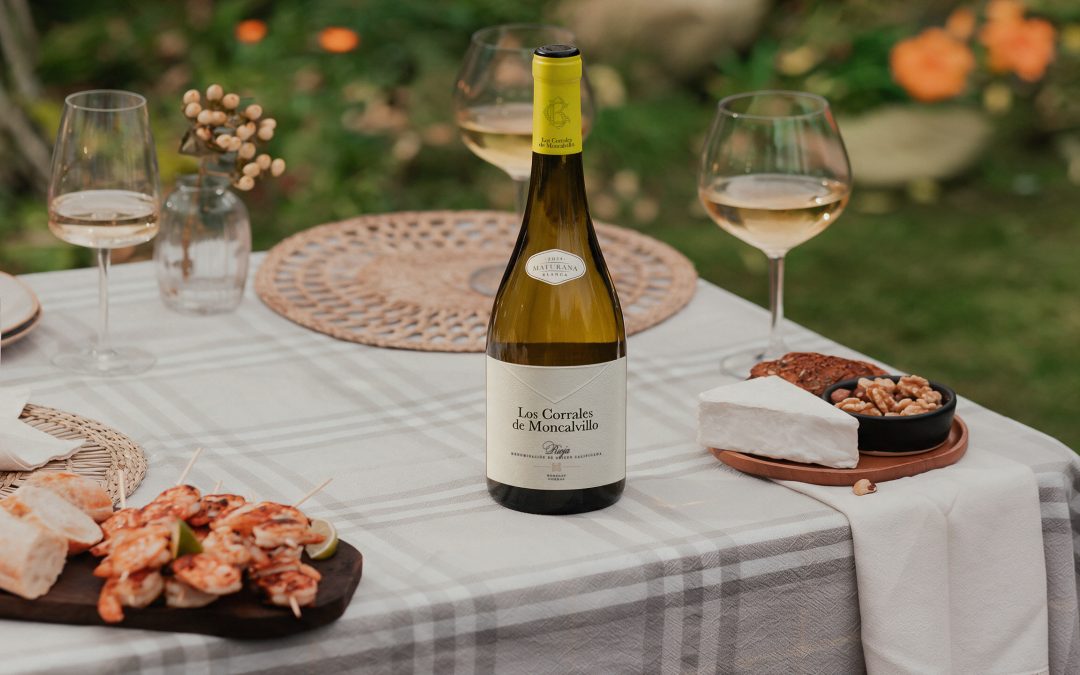
Maturana Blanca from La Rioja: Los Corrales de Moncalvillo, a white wine with its own distinct character
A historic grape variety that helps us understand the great white wines of La Rioja
What makes a white wine special? The grape variety, its origin, the winemaking process, and, above all, its ability to express its own identity. In Los Corrales de Moncalvillo Maturana Blanca, we find an answer that takes us directly to the winemaking history of La Rioja and to one of its most unique grape varieties.
With this wine, we celebrate our region’s winemaking heritage through a lesser-known grape variety that nearly disappeared. The goal is not to produce a white wine that imitates other styles, but rather to offer a contemporary interpretation of a historic variety—one capable of combining character, body, and complexity without sacrificing freshness.
Because when we talk about great wines, understanding what lies behind each bottle is also part of the experience.
White Maturana: A unique grape in La Rioja
The white Maturana holds a special place in the history of La Rioja’s vineyards. It is considered the oldest variety for which there is written record in La Rioja, with documented references dating back to 1622. Furthermore, the historical literature consulted by the winery indicates that it was cultivated exclusively in this region.
However, its history nearly came to an end. Its low yield contributed to its gradual disappearance from the vineyards, to the point where its recovery became essential to preserving this viticultural heritage.
The work of a research group at the University of La Rioja made it possible to recover the variety from an old vineyard in Navarrete, the town where our winery is located. Thanks to this effort, the white Maturana has regained a presence in the Rioja wine scene, although it remains a minority variety within the DOCa Rioja.
Today, this grape offers us the opportunity to produce a distinctive white wine, deeply connected to its terroir and with its own unique characteristics. It is a way of looking to the past to continue advancing in the production of today’s white wines.
How We Make Los Corrales de Moncalvillo Maturana Blanca
A wine’s character also depends on the decisions we make in the winery. In this case, as Daniel Hernando, winemaker at Bodegas Corral, explains, “We don’t want a white wine in which the oak overpowers the grape. We want a white wine with character, body, and complexity, but one in which freshness remains the star.”
To achieve this, we use two complementary winemaking methods.
50% of the wine is aged in 500-liter French oak barrels. During this phase, we perform weekly bâtonnage, a technique that involves suspending the fine lees through controlled agitation. Our goal is to add more body on the palate, integrate the texture, and enhance complexity and length.
The other 50% remains in stainless steel tanks on its fine lees, without being stirred. This portion helps preserve a more direct expression of the fruit and the grape variety, maintaining freshness as one of the wine’s fundamental characteristics.
Fine lees are the yeasts that remain after fermentation and can continue to contribute nuances during the wine’s aging. In Los Corrales de Moncalvillo Maturana Blanca, their role goes beyond texture: they are part of a winemaking process designed to balance body, complexity, and freshness. While working with the lees in barrels helps to add breadth and persistence on the palate, keeping them in tanks without stirring allows for a more direct expression of the variety. Two distinct approaches that serve the same goal: ensuring that the Maturana Blanca retains its identity.
The result we seek arises precisely from the interplay between these two winemaking methods: one contributes depth and breadth; the other, freshness and a more direct expression of the Maturana Blanca. The oak provides a backdrop, but the grape remains the central focus.
 A white wine to enjoy from a different perspective
Los Corrales de Moncalvillo Maturana Blanca is designed for those seeking more than just a conventional white wine. Its concept is rooted in a grape variety with a rich history and a winemaking process focused on respecting its character, without sacrificing the possibilities offered by modern winemaking techniques.
It is also an invitation to better understand the diversity of La Rioja. Because behind an internationally recognized appellation lies a heritage of grape varieties, vineyards, and winemaking methods that deserves to continue growing and finding its place.
A bottle with a story to tell and a clear vision: to reclaim a part of our winemaking identity so we can continue producing wines with their own distinct character.